
WaveTrackR
UI & UX Design for a Recruitment Tech Platform
WaveTrackR is Wave's recruitment technology platform, powering job posting, candidate attraction, and application management.
As Lead UX/UI Designer, I reworked core workflows based on user feedback, refreshed the platform's look and feel in line with Wave's new branding, and introduced a scalable Figma design system to ensure consistency across platforms. I worked closely with product managers, developers, and stakeholders to explore problems, shape solutions, and iterate designs within an active production environment. The redesign focused on three key improvements: the Job Summary page, a streamlined Posting Workflow, and AI-Powered Screening
Role
Lead UX/UI Designer
Scope of work
End-to-end feature design across recruiter dashboards, candidate management, job posting workflows, and AI-assisted screening tools
Focus areas
Complex, data-dense interface design; improving recruiter efficiency and scan-ability; evolving core workflows; and establishing scalable UI and design system foundations
Product
B2B recruitment and applicant-tracking platform (WaveTrackR)
Constraints & considerations
Long-standing legacy UI, deeply embedded recruiter workflows, and the need to introduce UX /UI improvements in a considered, iterative way. The work focused on reducing cognitive load for recruiters while supporting faster, more confident hiring decisions.
Environment
Live production platform with continuous feature delivery
Job Summary Page
From Overview to Applicant Management
Context
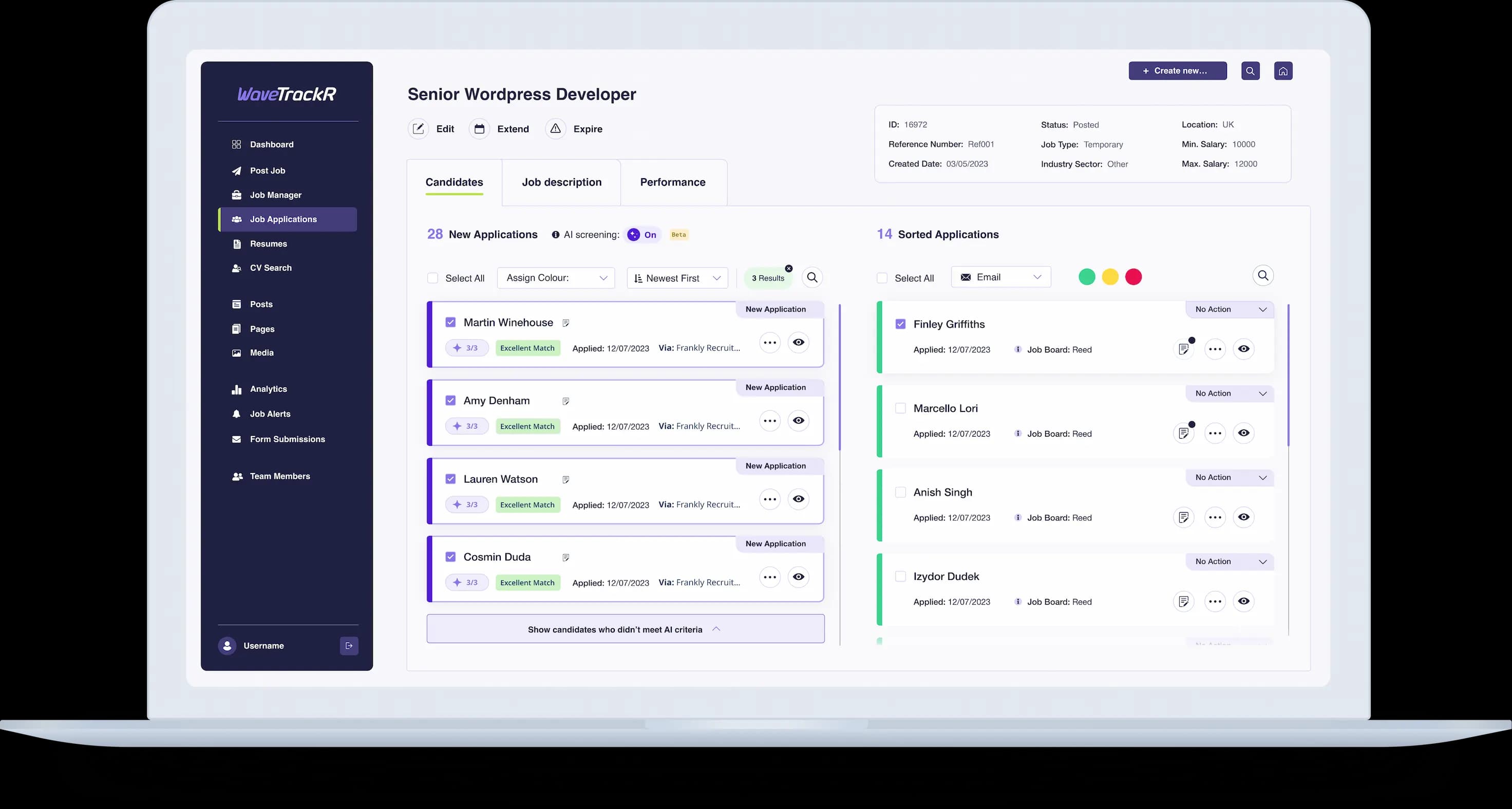
Recruiters needed a fast way to assess the health of a job posting and manage its candidates, but existing views required scanning multiple screens and interpreting dense, inconsistent information. This made it difficult to stay focused while working through large volumes of applications.
Approach
We focused on how recruiters prioritise candidates under time pressure, designing around clear visual hierarchy, contextual grouping, and progressive disclosure to reduce cognitive load while keeping recruiters oriented within a single job.
Solution
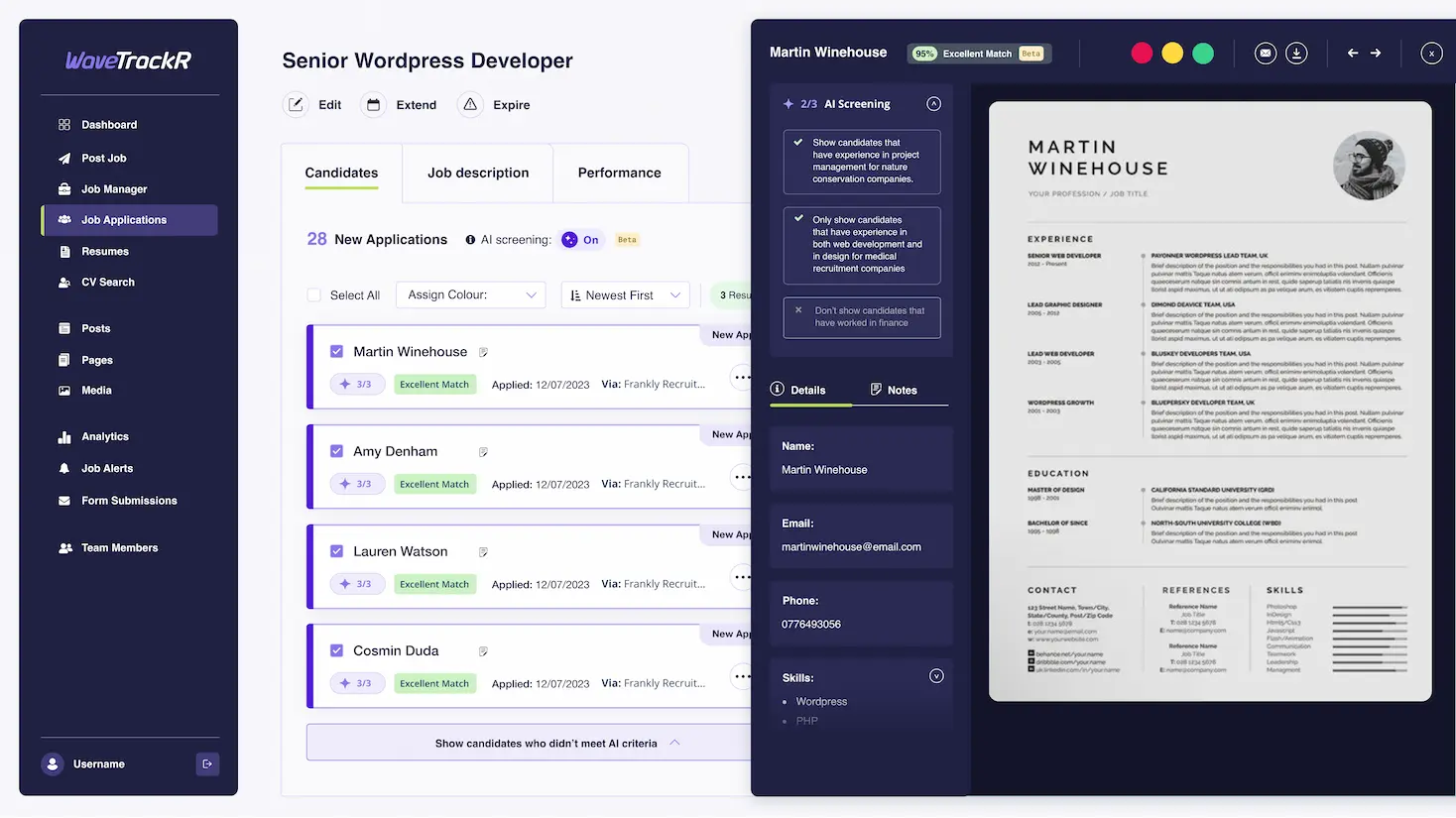
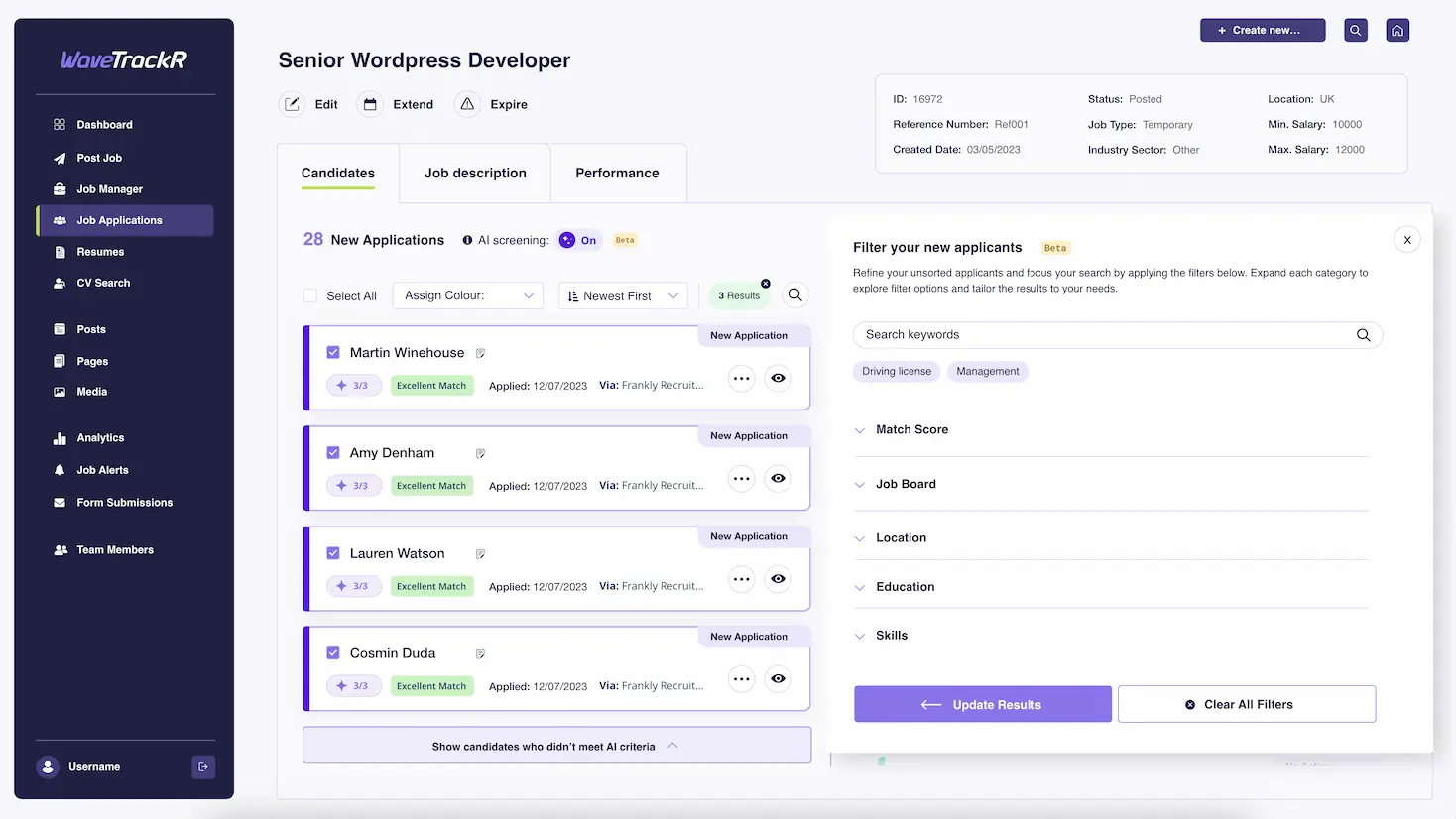
I designed a job summary dashboard that acts as a central workspace for a role, bringing key job metrics, candidate status, and AI-assisted insights into one cohesive view. High-level signals such as application volume, candidate progression, and strong matches are surfaced first, with deeper candidate detail available only when needed through CV previews and parsed information. This enables faster prioritisation while preserving the ability to review candidates in depth.
Redesigning the Posting Workflow
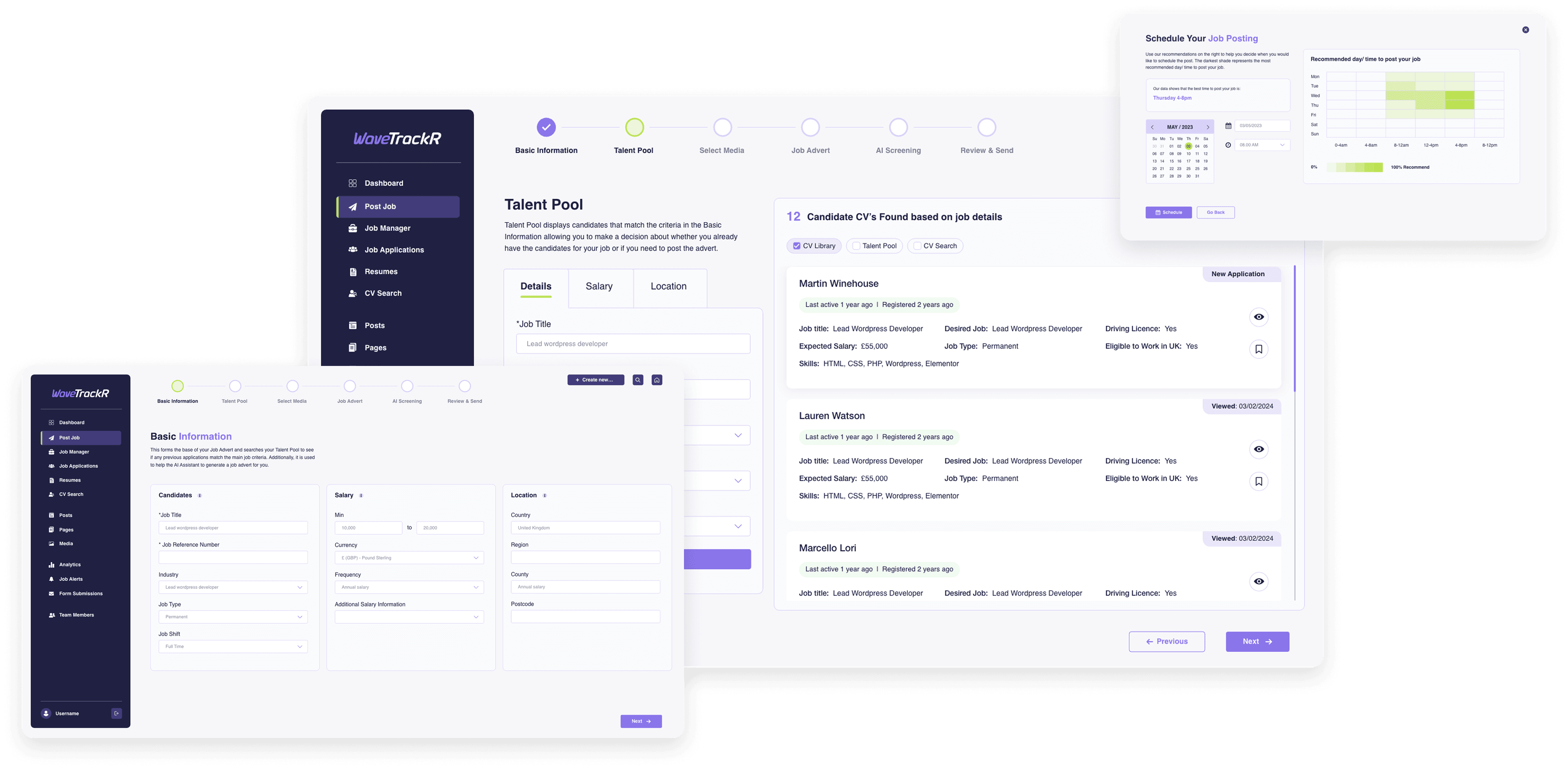
Context: Creating and managing job posts was time-consuming and error-prone, with recruiters required to move through long forms and remember contextual requirements while balancing speed and accuracy.
Approach
We explored how recruiters mentally model job creation, structuring the flow around the way they naturally provide information, starting with core job details that later inform downstream workflows such as talent pooling and AI-assisted job description generation.
Solution
I redesigned the job posting flow to feel more structured and intentional, clarifying required inputs, reducing cognitive load, and aligning early decisions with later automation and matching features. This enabled faster, more confident job creation without disrupting established recruiter habits.
AI-Powered Screening
Context
Recruiters receive large volumes of applications, making it time-consuming to identify strong candidates through manual CV review alone.
Approach
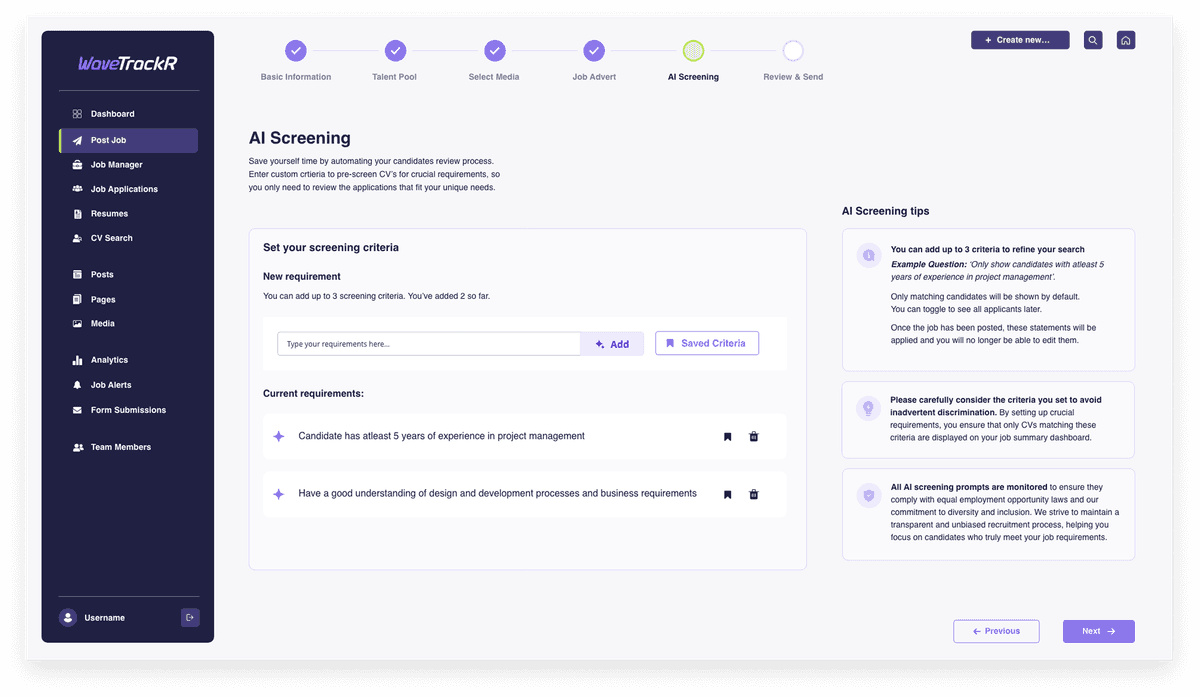
I designed AI-assisted screening to complement existing recruiter workflows, balancing familiarity with clear added value. The solution was informed by established AI interaction and disclosure patterns, with ethical considerations, such as transparency, bias mitigation, and non-exclusion, treated as core design constraints. The AI experience was aligned with existing layout and interaction patterns so it felt integrated rather than disruptive.
Solution
AI screening criteria were embedded directly into the job posting and job summary experience, using familiar page structures to reduce cognitive load. Strong matches are surfaced through clear visual indicators, with contextual tags and CV previews explaining which criteria candidates meet.
All candidates remain visible. AI supports prioritisation without blocking applications, reducing review time while maintaining trust, fairness, and recruiter control.